
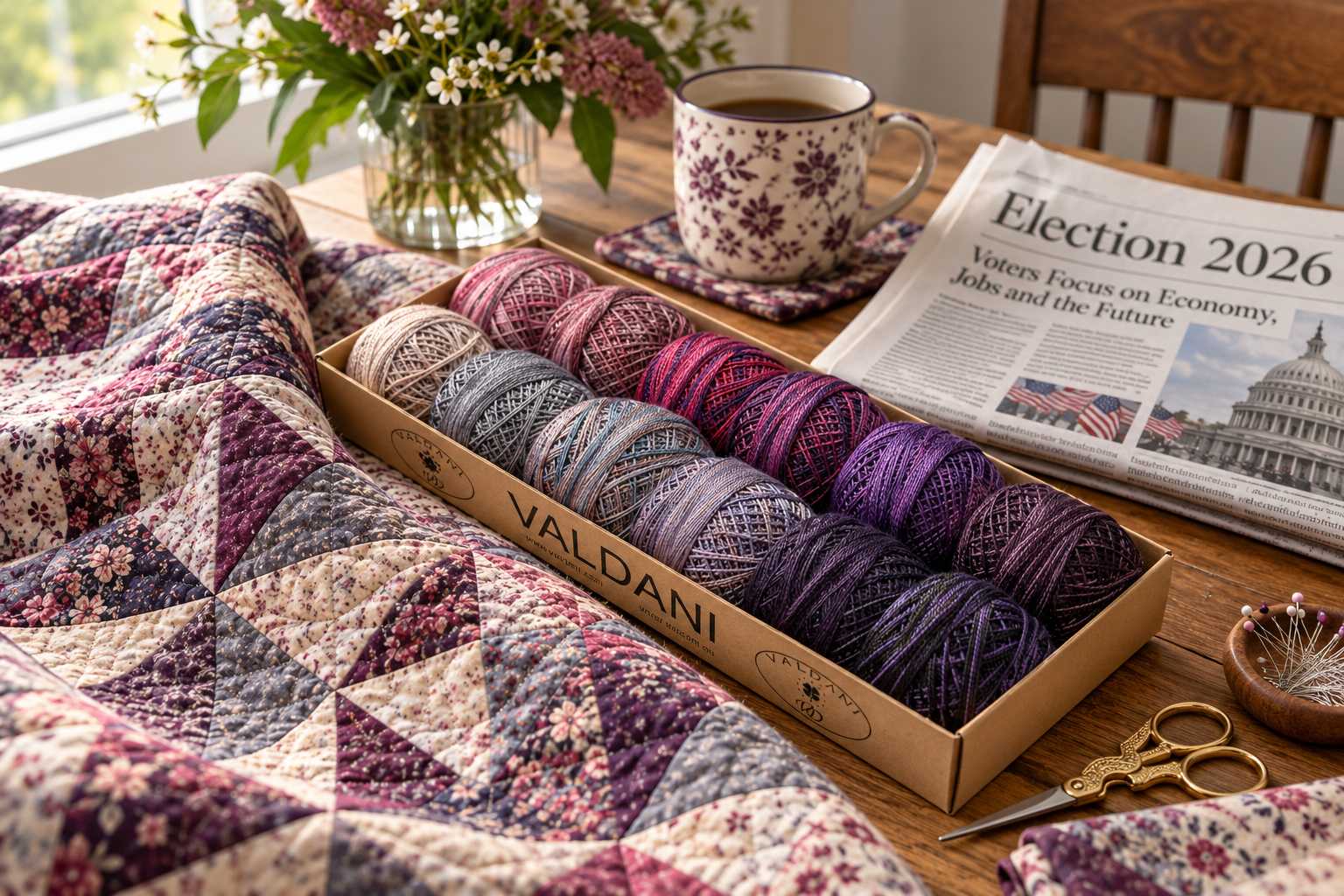
Why political uncertainty may influence craft purchases, retail inventory, and consumer confidence—even when enthusiasm for creativity remains strong.
October 2026 | Craft Industry Insights
Something interesting happens in consumer markets during periods of economic and political uncertainty. People don't necessarily stop enjoying the things they love. But they may become more cautious about spending money on them. For the quilting, embroidery, sewing, crochet, and needlework industries, this raises an important question:
Can an election influence how much consumers spend on their hobbies?
With the 2026 U.S. midterm elections approaching, the question is particularly relevant. Independent craft retailers, designers, distributors, and manufacturers all depend on purchasing decisions that can be influenced by consumer confidence.The relationship between elections and spending, however, is more complex than it might seem.
1. Elections Create Questions About the Economic Future
Election campaigns naturally bring economic issues into focus.
Consumers hear discussions about inflation, taxes, employment, interest rates, trade policies, and the cost of living. Even when their personal finances have not changed, uncertainty about the future may encourage some households to postpone nonessential purchases. Research published in the American Economic Review in 2024 found that increased macroeconomic uncertainty can lead households to reduce spending across a broad range of categories.This matters for the craft industry because many craft purchases are discretionary.
A quilter may love a beautiful new fabric collection but decide to finish an existing project first. An embroiderer may postpone purchasing another assortment of specialty threads. A crocheter may choose to work through yarn already in their collection.The desire to create hasn't disappeared.The decision to spend has simply been delayed.
2. Why Craft Retailers May Feel the Effects More Strongly
The craft industry has a distinctive supply chain, with independent retailers playing an essential role.When customers become more selective, retailers often respond by adjusting inventory purchases.Consider a hypothetical needlework shop that normally sells 100 units of a popular product each month.If customer demand falls by 15%, the store might sell 85 units. But if the owner also wants to reduce existing inventory, the next wholesale order could fall much more sharply.
This illustrates an important distinction:
A decline in wholesale orders does not necessarily reflect an equally large decline in consumer demand.
Retailers may be purchasing less because they are managing inventory, protecting cash flow, or waiting for clearer economic conditions. For manufacturers and distributors, the resulting slowdown can feel sudden, even when consumers continue buying products.
3. What Does Research Tell Us About Election-Year Spending?
There is evidence that economic uncertainty influences household spending, but the specific impact of elections is less straightforward. In an October 2026 survey, Pew Research Center reported that 84% of registered U.S. voters considered the economy very important to their midterm vote.This illustrates how central economic concerns have become during the current election period.
However, a July 2026 Bank of Canada working paper examining U.S. presidential elections since 1980 found that large changes in political economic sentiment often produce relatively little change in actual household spending. Why the difference? Consumers may express concern about the national economy while continuing to make purchasing decisions based primarily on their own employment, savings, income, and financial circumstances.
The conclusion is important: elections may contribute to consumer caution, but an election alone cannot explain a decline in craft sales.
Inflation, seasonal demand, household budgets, retailer inventories, and changing shopping habits must also be considered.
4. Why Crafting Can Remain Popular Even When Sales Slow
One of the most fascinating aspects of the craft industry is that purchasing activity and participation are not necessarily the same thing. People can spend less money on craft supplies while spending more time crafting. During uncertain periods, creative hobbies may offer something especially valuable: relaxation, accomplishment, and a break from everyday pressures. Quilting, embroidery, hand sewing, and crochet encourage concentration and creativity. They provide the satisfaction of making something tangible in an increasingly digital world.Consumers may respond to tighter budgets by rediscovering unfinished projects, experimenting with materials already at home, or choosing smaller projects.This creates an interesting possibility.
Craft participation can remain healthy even during a period of weaker retail sales.
For businesses, understanding that distinction is essential. Reduced purchasing does not automatically indicate reduced enthusiasm for the hobby.
5. The Hidden Influence of Consumer Attention
Money is not the only factor affecting purchasing behavior. Attention matters too. During election periods, news coverage, political discussions, and economic commentary can occupy a substantial share of consumers' daily attention. For online retailers, this creates additional competition. A customer who normally enjoys browsing quilting fabrics or discovering new embroidery patterns may spend less time exploring new products. Promotional emails may receive less attention. New collections may take longer to generate excitement. Some purchasing decisions may be postponed. These are plausible effects of a crowded information environment, although their specific impact on craft sales has not been established. For craft businesses, this is a reminder that a quieter sales period does not always mean customers have lost interest. Sometimes businesses are competing not only for customers' money, but also for their attention.
6. Will Craft Sales Recover After the Election?
It is tempting to assume that spending will automatically improve once an election is over. In reality, there is no guarantee. An election resolves uncertainty about who will hold office, but it does not necessarily resolve uncertainty about household finances, inflation, employment, or economic policy. Some consumers may feel more comfortable making postponed purchases. Others may remain cautious. The direction of spending will depend on actual economic conditions and consumers' personal financial circumstances. For the craft industry, seasonal patterns add another layer of complexity. Autumn traditionally leads into holiday shopping, gift-making, and winter projects. A slowdown during this period should therefore be evaluated against previous years, seasonal expectations, and broader retail trends before attributing it to an election.
7. What Does This Mean for the Craft Industry?
Periods of uncertainty are an opportunity for craft businesses to understand their customers more closely. Independent retailers may benefit from focusing on dependable products, manageable inventory levels, and projects that offer customers strong value. Designers can help maintain engagement by introducing approachable patterns, smaller projects, and creative ways to use existing supplies. Manufacturers and distributors can support retailers through reliable product availability, educational resources, and clear communication. Rather than responding to slower demand with aggressive discounting, businesses should first determine whether customers are buying less, delaying purchases, or simply changing what they buy. These distinctions can make a significant difference in business decisions.
8. A Temporary Slowdown or a Changing Market?
Perhaps the most important question facing craft businesses is whether weaker sales represent a temporary purchasing pause or a more lasting shift in consumer behavior. The answer cannot be determined from election timing alone. Businesses should look at several indicators: the number of transactions, average order values, repeat purchases, inventory turnover, website engagement, and customer feedback. If consumers continue showing interest in products but place smaller orders, financial caution may be playing a role. If retailers reduce wholesale purchases while maintaining relatively stable consumer sales, inventory adjustments may explain part of the decline. And if both customer engagement and purchasing activity weaken over an extended period, broader changes in demand deserve closer examination. Understanding the difference is more valuable than searching for a single explanation.
Final Thoughts: Creativity Doesn't Follow an Election Calendar
Elections can create uncertainty, intensify economic concerns, and influence how consumers think about their financial future. For discretionary industries such as quilting, embroidery, sewing, and needlework, these factors may contribute to more cautious purchasing behavior. But the relationship is not automatic, and the available research does not establish that elections consistently cause craft industry sales to decline. What remains clear is that crafting offers something beyond the products themselves. It provides creativity, relaxation, personal expression, and the satisfaction of making something beautiful by hand. Those motivations do not disappear when economic confidence weakens.
Consumers may change when and how much they purchase, but their passion for creating can remain just as strong.
For the craft industry, that is an important distinction—and a reason to approach uncertain markets with perspective, patience, and a clear understanding of customer behavior.
Research and References
Coibion, O., Georgarakos, D., Gorodnichenko, Y., Kenny, G., and Weber, M. (2024). The Effect of Macroeconomic Uncertainty on Household Spending. American Economic Review. https://doi.org/10.1257/aer.20221167
Pew Research Center (October 8, 2026). Economy Ranks as Top Issue in Midterms for All Voters. https://www.pewresearch.org/politics/2026/10/08/economy-ranks-as-top-issue-in-midterms-for-all-voters-but-partisans-differ-over-the-importance-of-other-issues/
Bank of Canada (July 2026). Seeing the Economy through Colored Glasses: Partisanship in Macro and (not in) Micro Expectations. https://www.bankofcanada.ca/2026/07/staff-working-paper-2026-24/
Published by the Valdani Team | Craft Industry Insights